

— Silicium G7® · Clinical-Premium · Original formula
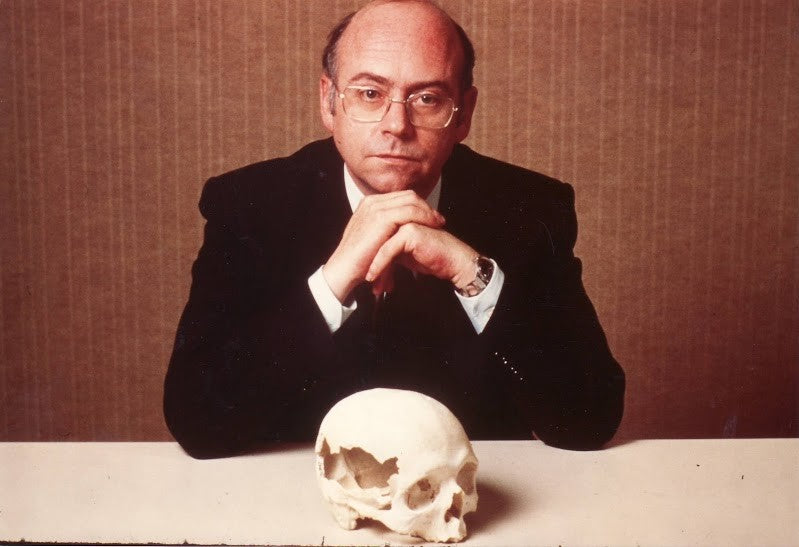
Dr. Loïc Le Ribault, the scientist who characterized bioavailable organic silicon.
French geologist and forensic criminologist (1947–2007). In 1985 he showed that mineral silicon does not cross the intestinal barrier and characterized stabilized orthosilicic monomer in an organic matrix as a bioavailable form. That formula, refined, is now the Heritage Concentrate® active in Silicium G7®.
University of Bordeaux
Forensic criminologist
Foundational laboratory
Original forensic technique
Le Prix d’une Découverte · 2003
Industrial transfer 2010
By 28, he was already running a leading forensic laboratory in France.
Loïc Le Ribault was neither a communicator nor a salesman: he was a laboratory scientist. He was born in Vannes (Brittany) in 1947, the son of two teachers. He earned his doctorate in Geology from the University of Bordeaux and founded CARME —Centre d’Analyses et de Recherches en Microscopie Électronique—, which within a few years became the reference laboratory for the French Ministry of Justice.
What matters is not the résumé. What matters is that when Le Ribault discovered organic silicon, he was not a technician selling a supplement: he was a rigorous scientist who had spent years looking at quartz grains under an electron microscope. He knew how silicon behaves in nature. And that led him to ask the question no one else was asking: if mineral silicon in water is not assimilated, what had to happen for the human body to actually use it?
This page tells that story. It matters because the formula he published in 1985 is the same one that is now inside the bottle of Silicium G7®. What changes between one silicon brand and another is not marketing: it is whether they have the right active ingredient or not. And only one company in Europe has Le Ribault's direct industrial chain. This one.
The insight began at a crime scene.
Before organic silicon, Le Ribault invented something just as revolutionary: electron exoscopy. It was 1969 and he was 22 years old. He showed that the surface of any grain of sand retains, on a microscopic scale, the trace of every place it has passed through. Water, wind, fire, a footprint at a crime scene.
And this matters. Le Ribault was not a «supplement discoverer». He was a scientist whose analysis method is taught today in universities. When a man like that tells you mineral silicon is not absorbed and that there is a way to make it bioavailable, it is not an opinion: it is repeatable, peer-reviewed laboratory work. And that is what changes everything.
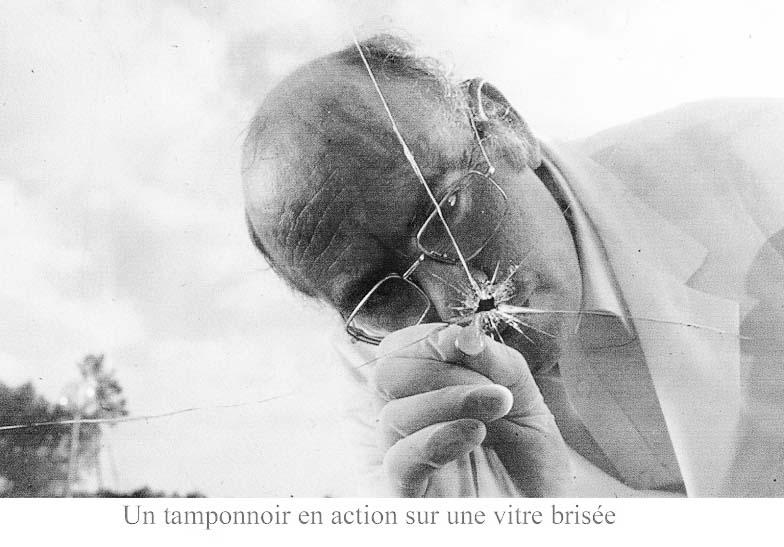
Quantico sent him three envelopes of sand. He got all three right.
In 1985, the FBI sent the Bordeaux CARME three sand samples to identify blind. A note: «These three samples were collected in three different places on the planet. What is their history and where do they come from?». This is what he answered:
Atlantic coast
«Mixture of coastal sand from the eastern United States.» Correct: calibrated mixture across 300 km of coastline.
Mount Saint Helens
«Volcano in a temperate climate, probably Saint Helens.» Correct: a car hood after the eruption.
Beirut embassy
«Middle Eastern city with limestone mountains, subjected to a non-natural explosion.» Correct: remains of the bomb truck.
After that, Quantico started calling him for real cases. A person who can read the history of a grain of sand can also read the chemistry of silicon inside the human body. That is why his discovery of organic silicon that same year was no coincidence: it was the natural consequence of knowing how to look.
The same year he writes to the FBI, he proves that everything we thought we knew about silicon was wrong.
The medical consensus in 1985 said silicon was an «trace element»: the body absorbed it from water and dietary silicates. Le Ribault, in the lab, proved the opposite. Mineral silicon —silicates, colloidal silica, silicon dioxide— passes through the intestine without being assimilated. The only bioavailable form is the orthosilicic acid monomer stabilized in an organic matrix with carbon.
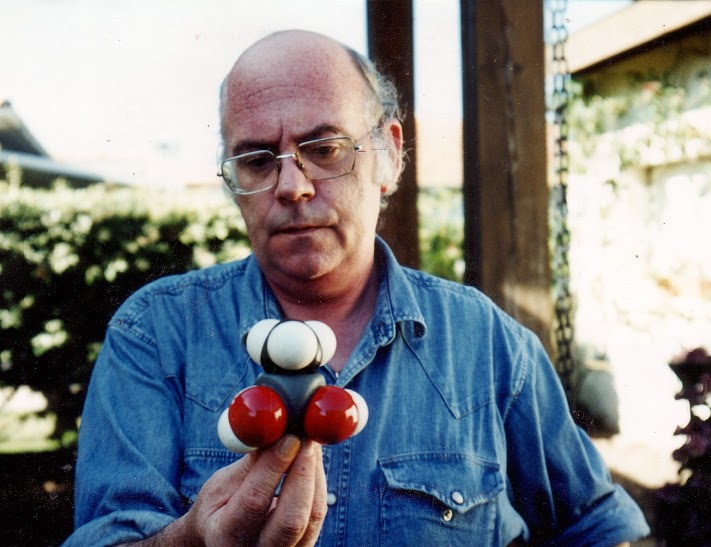
The silicon the human body needs must be bound to a carbon atom. Without that bond, it does not cross the intestinal wall.— Dr. Loïc Le Ribault · Le Prix d’une Découverte (2003)
What matters in practice is this: most silicon supplements on the market —bamboo, horsetail, colloidal silica— do not work as they claim. Their silicon does not cross the intestinal barrier because it lacks the carbon bond discovered by Le Ribault.
Le Ribault developed the industrial method to stabilize the monomer and registered several patents with INPI (France) and EPO (Europe) between 1985 and 1992. The first product he brought to market was called G5. That same formula, refined, is now Heritage Concentrate®, the active ingredient in Silicium G7®.
They took away his laboratory, jailed him, and he spent his final years in exile.
In the mid-1990s, Le Ribault began receiving accounts from people who improved after taking G5: athletes, women with osteoporosis, people with osteoarthritis. He collected them —as a scientist, they were data— but he never prescribed anything. He was still persecuted.
The first trial came in 1995. Charges: «illegal practice of medicine» and «misleading advertising». He was jailed. In 1997 he went into secret exile: he crossed Belgium, reached England, and settled in Jersey, where he resumed research under scientific status. He remained in exile for more than a decade, traveling without a passport, until his death in 2007.
What matters to you as a reader: there was never any scientific objection to his work. No article in peer-reviewed journals refuted his measurements. The persecution came from the regulatory sphere. In 2016, nine years after his death, the EFSA approved the active ingredient as a Novel Food. They gave him credit. Too late.
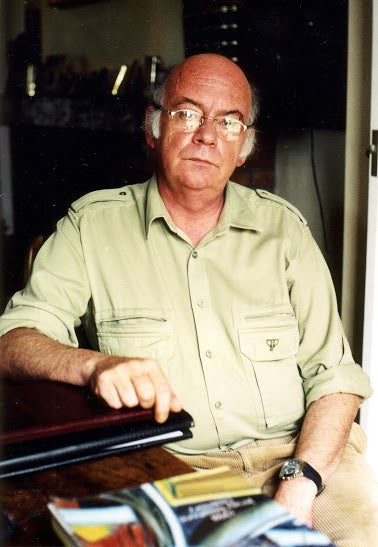
When a journalist asked him in Jersey how he described himself, he answered in three words:
A permanent exile as well as a repeat offender.
A permanent exile and, moreover, a repeat offender.
Collected by Martin J. Walker in Le détective dissident (2010, Slingshot Publications)From the 1985 formula to today's Heritage Concentrate®.
In 2010, three years after his death, Silicium Laboratories Europe completed the direct industrial acquisition of the legacy: original culture strain, manufacturing equipment, scientific archives, and quality-control protocols.
Heritage Concentrate®
Specifically: when you open a bottle of Silicium G7®, you are taking a liquid made with the same monomer stabilization process Le Ribault developed in 1985. Same active ingredient. Same industrial method. Same quality-control tests. The only thing that has changed in forty years is the plant where it is made —now in Oiartzun, Gipuzkoa, GMP facilities— and the amount of published clinical research on the active ingredient: more than 70 studies to date.
Approved by the EFSA as a Novel Food (EU Regulation 2017/2470). More than 70 clinical studies published on the active ingredient.
Sixty years, two discoveries, a legacy.
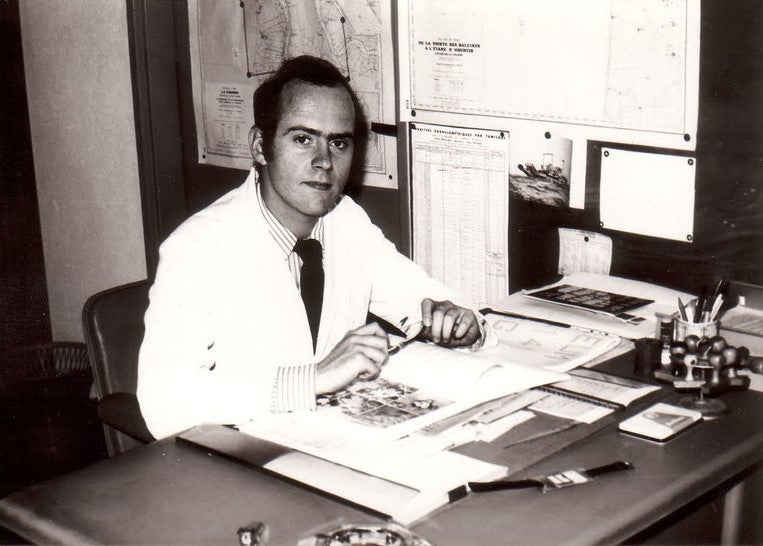
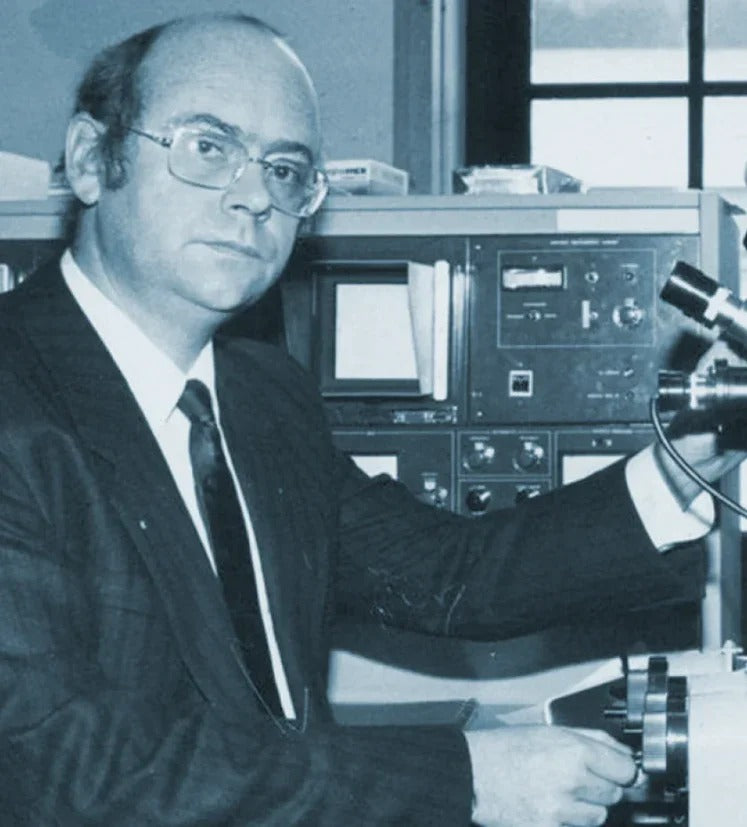
- 1947Born in Vannes (Brittany, western France). Son of a teacher father and a mother who taught natural sciences.
- 1971Doctorate in Geology from the University of Bordeaux. Foundational thesis on exoscopy.
- 1972–95He founds and runs CARME in Bordeaux · more than fifteen hundred homicide expert reports with a 95% success rate.
- 1985He contacts the FBI and discovers bioavailable monomeric organic silicon.
- 1992First commercialization of the active ingredient under the name G5 Silicium in France.
- 1995–97Legal proceedings in France. First imprisonment.
- 1997Secret exile: Belgium → England → Jersey.
- 2003Publishes Le Prix d’une Découverte in English.
- 2007Dies in Saint-Pée-sur-Nivelle at 59.
- 2010Silicium Laboratories Europe completes the industrial acquisition. Heritage Concentrate® is born.
- 2016EFSA approves the active ingredient as a Novel Food (EU Regulation 2017/2470). Posthumous rehabilitation.
The scientific lineage of Heritage Concentrate®.
Different forms of silicon coexist on the market: bamboo extracts, horsetail, colloidal silica, and stabilized monomeric organic silicon. The form with the strongest base of human clinical studies is stabilized orthosilicic monomer in an organic matrix, the line of research opened by Le Ribault in 1985.
And among the products that use that form of the active ingredient, only one in Europe has a direct industrial chain back to Dr. Le Ribault's original laboratory: the formula, equipment, and protocols transferred in 2010. It is Heritage Concentrate®, the active ingredient inside Silicium G7®.
When you buy Silicium G7® you are not buying «just another brand». You are buying the only unbroken chain from 1985 to today, with more than 70 published clinical studies on the active ingredient, EFSA approval as a Novel Food (EU Regulation 2017/2470), and batch traceability from the GMP plant in Oiartzun.
What we are asked most often.
Six common questions we receive about Le Ribault and the formula.
Loïc Le Ribault (1947–2007) was a French geologist and forensic criminologist, inventor of electron exoscopy and discoverer of bioavailable monomeric organic silicon. He was born in Vannes (Brittany), earned his doctorate at the University of Bordeaux, and founded CARME (Centre d’Analyses et de Recherches en Microscopie Électronique).
In 1985 he showed that mineral silicon was not bioavailable and that the only form assimilable by the human body was the orthosilicic acid monomer stabilized in an organic matrix with carbon. He patented the stabilization process with INPI and EPO between 1985 and 1992.
Silicium G7® contains Heritage Concentrate®, the original Le Ribault formula industrially acquired by Silicium Laboratories Europe in 2010. It is not an «inspired by» version: it is the same strain, the same process, the same protocols. Bioavailability of 64% in healthy humans —35× higher than colloidal silicon— supported by more than 70 published clinical studies.
His discoveries contradicted the prevailing academic model and the interests of the French pharmaceutical industry. He faced proceedings for illegal practice of medicine from the mid-1990s onward. After a first imprisonment he went into secret exile (1997) via Belgium and finally to Jersey. His scientific work was never refuted in peer-reviewed journals.
Yes. Well tolerated, with no relevant adverse effects in more than 23 years of pharmacovigilance. NOAEL 2,000 mg/kg/day in OECD GLP studies. EFSA approved the active ingredient as a Novel Food in 2016 (EU Regulation 2017/2470). During pregnancy, breastfeeding, or medical treatment, consult your healthcare professional. Details in contraindications.
His main books are Le Prix d’une Découverte (2003, in English) and Qui a Peur de Loïc Le Ribault?: 2 Inventions de Trop (in French, 500 pages). The most consulted biography is Le détective dissident by Martin J. Walker (2010). Scientific publications derived in the clinical library.
Organic silicon, from six angles.
Each page answers a different question.
Organic silicon guide
The complete foundation. What it is, how it works, and why it matters.
Read the guide → 02Benefits of silicon
Six verified clinical effects.
See benefits → 03Silicon comparison
MMST vs orthosilicic acid vs colloidal.
Compare → 04How to take silicon
Dosage, oral, topical, and cosmetic use.
See dosage → 05Contraindications
Safety profile. 23 years of pharmacovigilance.
See details → 06Clinical studies
70+ studies over 44 years.
See evidence →The team that backs this page.
The content is signed by the person who writes it and the person who reviews it.
Juan Carlos Hierro
Director · Silicium Laboratories Europe
Industrial lead for the transfer of Heritage Concentrate® since 2010. More than 23 years working with Dr. Le Ribault's original formula in GMP plant in Oiartzun.
Dr. Maria del Mar Sabaté Martínez
PhD Biochemistry · Universitat Rovira i Virgili
Academic review of Le Ribault's theoretical framework and the derived publications. Verification of biographical claims with documentary sources.
From his laboratory to your bottle, without scientific intermediaries.
The formula Le Ribault characterized in 1985 is made today in the GMP plant in Oiartzun, using the same protocols. It is Heritage Concentrate®, the active ingredient in Silicium G7®. More than 70 published clinical studies support its use.